intel artifacts

The Telco terrain map

April 2, 2026

This intel artifact is an attempt to understand the main constraints that dictate the dynamics we’re observing in the telco industry.

Key points

  • Every actor is individually rational. Aggregators, regulators, hyperscalers, internal teams, each one is behaving logically within their own incentive structure. The dysfunction is emergent, not caused by one actor.
  • The system punishes action. Cleaning up traffic shrinks KPIs. Modernizing infrastructure carries political risk. Raising prices drives hyperscalers away. Every rational move makes the operator’s position worse in the short term.
  • The chaos hides the decline. Inflated metrics from bot traffic, fraud loops, and grey routes make the business look healthier than it is, removing the urgency to act on a problem that’s compounding underneath.

Introduction

The telecom market is trapped in an incentive-structure failure.

Six constraints interlock to create a system where every actor is stuck: regulators freeze the rules, aggregators exploit the gaps, hyperscalers control the economics, legacy infrastructure can’t adapt, internal politics block change, and, most critically, the chaos itself becomes a reason not to act.

Inflated metrics and dirty data provide political cover that makes the real problem harder to see and harder to fix. These constraints don’t just coexist, but also reinforce each other. This document maps how the trap works.

The messy reality

At its core, the telecom A2P market is suffering from an incentive-structure failure. The industry was built on a model where incentives no longer match reality.

  • In some markets, regulators force operators into fixed low prices that encourage grey routes and make quality impossible. In others, operators raise international termination rates only to watch hyperscalers immediately shift traffic to cheaper channels like WhatsApp, collapsing volumes and revenue overnight.
  • Everywhere, aggregators are rewarded for finding cheaper, uncontrolled routes; regulators impose rigid pricing rules that operators cannot challenge; governments enforce policies that freeze modernization; and operators are left carrying all the risk, cost, and blame.
  • And the chaos itself becomes a trap: inflated traffic and bot-driven volumes can make the telco numbers look stronger than they are, creating a hidden disincentive for operators to pursue the very clarity that would fix the system.
  • Externally, this distorted incentive structure collides with a legacy infrastructure that was never designed to handle modern A2P dynamics: bursty OTP traffic, global fintech flows, sophisticated fraud, and the exponential growth of digital services.
  • Internally, operators face their own incentive paralysis: CAPEX-heavy upgrades that are politically sensitive, multi-year projects they avoid touching for fear of outages, and organizational structures that slow every decision.
  • In this environment, from a telco operator perspective, doing nothing feels safer and even (short-term) financially-rewarding than acting: even as revenue leaks and control collapses.

Any solution to this system would have to address both sides of the incentive failure simultaneously, the external distortions and the internal paralysis, without requiring the operator to take on the very CAPEX risk and political exposure that keeps them frozen in the first place.
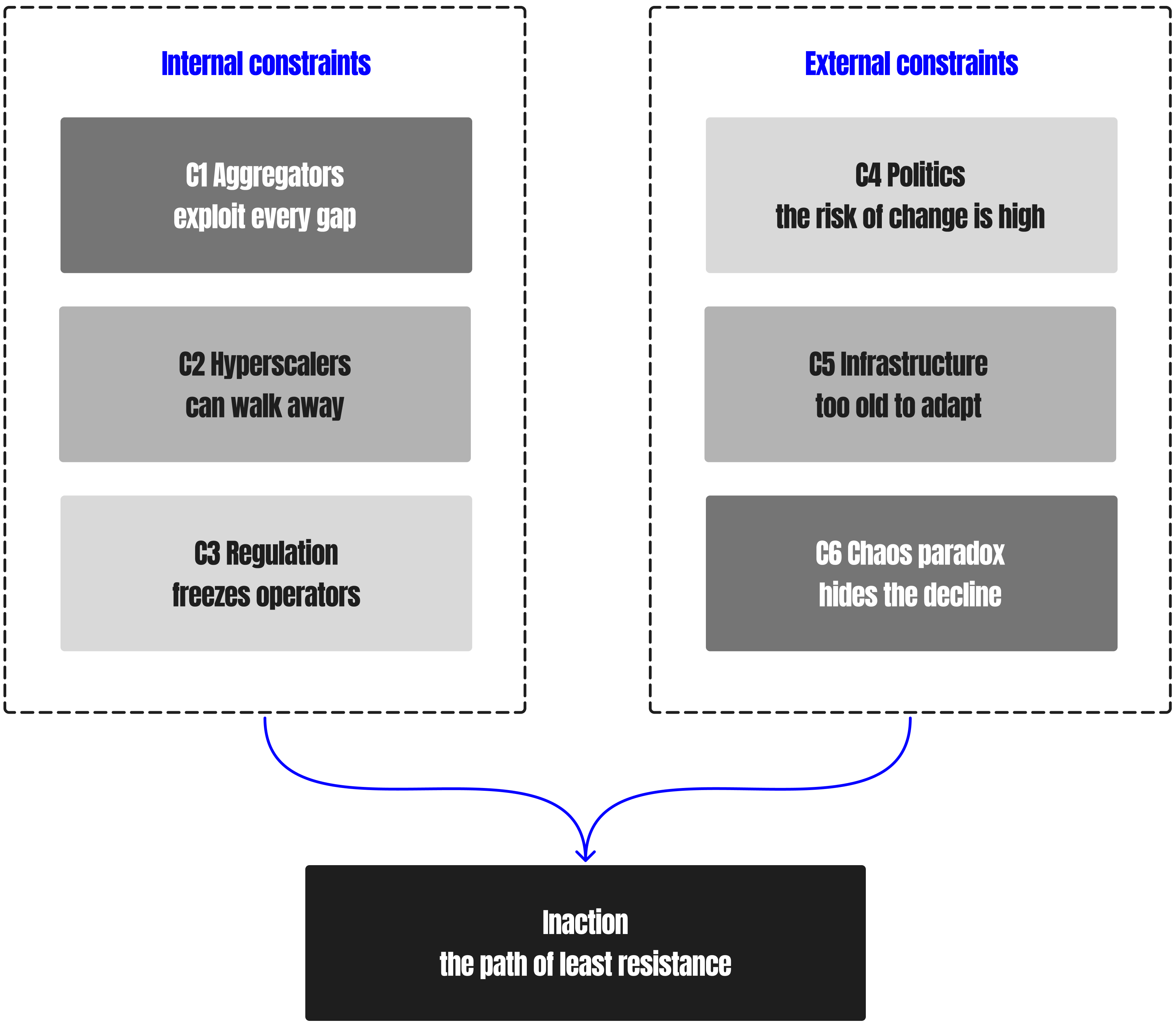
Six telco constraints, split between internal and external, converging on the same outcome: inaction.

The 6 constraints of the operator market

Constraint 1: Aggregators play by their own rules

Aggregators sit between enterprises and operators, and their entire business model is built on exploiting gaps in pricing, visibility, and regulation. They are rewarded for finding the cheapest possible route, even when it violates operator rules.

Why does this happen?

  • Aggregators compete on razor-thin margins
  • Enterprises only care about price + delivery, not operator rules
  • Operators have no visibility into aggregator behavior
  • The ecosystem was built assuming “trust” that never existed
  • Aggregators benefit from opacity; operators suffer from it

Why does this persist?

  • Because the incentive is misaligned.
  • Aggregators make more money when operators lose control.
  • They push traffic through: grey routes, SIM farms, unofficial STPs, unmanaged international hubs.

How does this trap operators?

  • Operators only see the mess after the damage: fraud spikes, spam floods, bypass bursts, unstable OTP delivery, enterprise escalations. Yet operators still get blamed, because enterprises assume “SMS = the operator.”

The impossible situation:

  • Aggregators profit from chaos, and operators pay for it. The operator has no leverage to change this.

Constraint 2: Hyperscalers control the economics

The largest buyers of A2P SMS, such as Google, Amazon, Apple, can shift their traffic instantly, negotiate globally, and decide whether SMS is “worth it” or not. Operators have zero leverage.

Why does this happen?

  • Hyperscalers are global, while operators are local
  • Hyperscalers own alternative channels (WhatsApp, RCS, in-app)
  • Hyperscalers send billions of messages
  • A tiny cost increase equals millions in spend
  • They can simply walk away

Why does this persist?

  • Because hyperscalers are economically more powerful than any individual operator.

How does this trap operators?

  • If they raise the costs → hyperscalers leave
  • If they don’t → grey routes take over
  • If they try to enforce → aggregators bypass
  • If they keep prices low → no revenue for upgrades

The impossible situation:

  • Operators are stuck in a lose-lose game created by global giants. The biggest customers can leave instantly, and operators have no say.

Constraint 3: Regulation creates the wrong incentive

The regulatory frameworks that govern SMS pricing, traffic, and enforcement were designed in the era of P2P messaging. They assume low volume, simple traffic, and predictable patterns, none of which remain true today.

Why does this happen?

  • Governments want to keep SMS cheap for citizens
  • Regulators don’t understand A2P realities
  • Pricing rules are political, not economic
  • Policy cycles are slower than technological cycles

Why does this persist?

  • Because regulatory bodies do not update pricing or enforcement rules fast enough, and operators lack political power to change them.

How does this trap operators?

Operators are forced into:

  • low fixed prices → grey routes explode
  • price ceilings → impossible to reinvest
  • limited enforcement rights → can’t block offenders
  • outdated frameworks → traffic prioritization impossible
  • no flexibility → can’t differentiate OTP from marketing

The impossible situation:

  • Regulation keeps operators frozen in yesterday’s model while today’s traffic is increasingly bigger and complex.

Constraint 4: Internal politics make change impossible

Operators are massive bureaucratic organizations with risk-averse cultures. Any change to core infrastructure requires cross-department alignment, budget requests, procurement cycles, security reviews, and political buy-in.

Why does this happen?

  • Telecom is a national-critical industry
  • Any outage becomes a political disaster
  • Legacy teams defend legacy systems
  • CAPEX budgets are controlled by finance, not engineering
  • Replacement projects take years
  • No one wants to sign their name under a risky modernization project

Why does this persist?

  • Because incentives inside the company reward stability, not innovation. A CTO who avoids disasters is rewarded more than one who attempts bold upgrades.

How does this trap operators?

  • upgrades get delayed for years
  • no one wants accountability
  • everyone fears being blamed
  • every decision is escalated
  • traffic problems accumulate without action

The impossible situation:

  • Operators end up doing nothing because doing anything feels dangerous. Inaction feels like safety, even though it guarantees decline.

Constraint 5: Telco infrastructure can’t keep up

P2P-era SMSCs, static firewalls, and legacy routing systems were never designed for OTP bursts, fintech flows, AI-driven fraud, or massive enterprise A2P traffic.

Why does this happen?

  • SMSC vendors stopped innovating years ago
  • Operators patched systems instead of replacing them
  • Traffic exploded faster than hardware cycles
  • Firewalls cannot classify modern patterns
  • Infrastructure is reactive, not predictive
  • Data visibility is fragmented or non-existent

Why does this persist?

  • Because upgrading is expensive, risky, political, and slow.
  • Operators “stretch” infrastructure instead of modernizing it.

How does this trap operators?

  • They lack: real-time classification, clean routing paths, fraud enforcement, traffic visibility, burst handling, dynamic filtering, and so many other things.

The impossible situation:

  • This makes them permanently reactive and permanently exposed. The foundation is too old for the world built on top of it.

Constraint 6: Telco benefits from the chaos it suffers from

The A2P ecosystem is filled with fake volume, bot-driven traffic, spam bursts, fraud loops, and grey-route patterns. Paradoxically, this chaos, apart from hurting operators, it also benefits them on paper. Inflated metrics make the business appear stronger, justify pricing increases, and maintain a weak infrastructure and lack of accountability.

Why does this happen?

  • Bot traffic inflates subscriber counts and “active user” metrics
  • Fraud & spam create the illusion of high A2P volume
  • Artificial traffic makes the network appear overloaded
  • Dirty data inflates KPIs that executives, regulators,and investors track
  • Telco can justify higher SMS prices based on “increased demand”

Why does this persist?

  • Clean traffic exposes the real subscriber base and volume
  • Fraud reduction makes KPIs look weaker at first
  • Infrastructure weaknesses is easy to hide
  • Transparency triggers internal accountability & political discomfort
  • Operators fear the optics: “If volume drops, we look like we performed worse.”

How does this trap operators?

  • They avoid fully cleaning traffic because it shrinks apparent KPIs
  • They tolerate grey routes and spam, as it inflates their “market size”
  • They can’t justify modernization internally when numbers look fine
  • They keep legacy vendors rather than upgrade

The impossible situation:

  • Operators live inside a paradox: the only thing that would save the ecosystem (clean, real traffic) is also the one thing that exposes the uncomfortable truth of the system. So chaos becomes both the problem and the political cover that sustains inaction.

The implication

Each player is doing what makes sense from their own position. Aggregators find the cheapest route because that’s how they survive on thin margins. Regulators keep prices low because that’s their mandate. Hyperscalers shift traffic when costs rise because that's basic procurement logic. Internal teams avoid risky upgrades because they get rewarded for stability, not innovation.

Nobody is being stupid or malicious. Everyone is following their own incentives correctly. The problem is that when all of those rational decisions combine, the system they produce is irrational: it traps everyone, including the people making the individually sensible choices.

That’s what makes it an incentive-structure failure rather than a competence failure. The dysfunction isn’t coming from anyone doing the wrong thing, but from the structure that connects all the right things into a deadlock.


Victoria Rudi

I help executives work through high-stakes situations they don’t have the bandwidth for by breaking them apart, applying the right analytical framework, and handing back a clear, usable readout.
book a call w/ Victoria